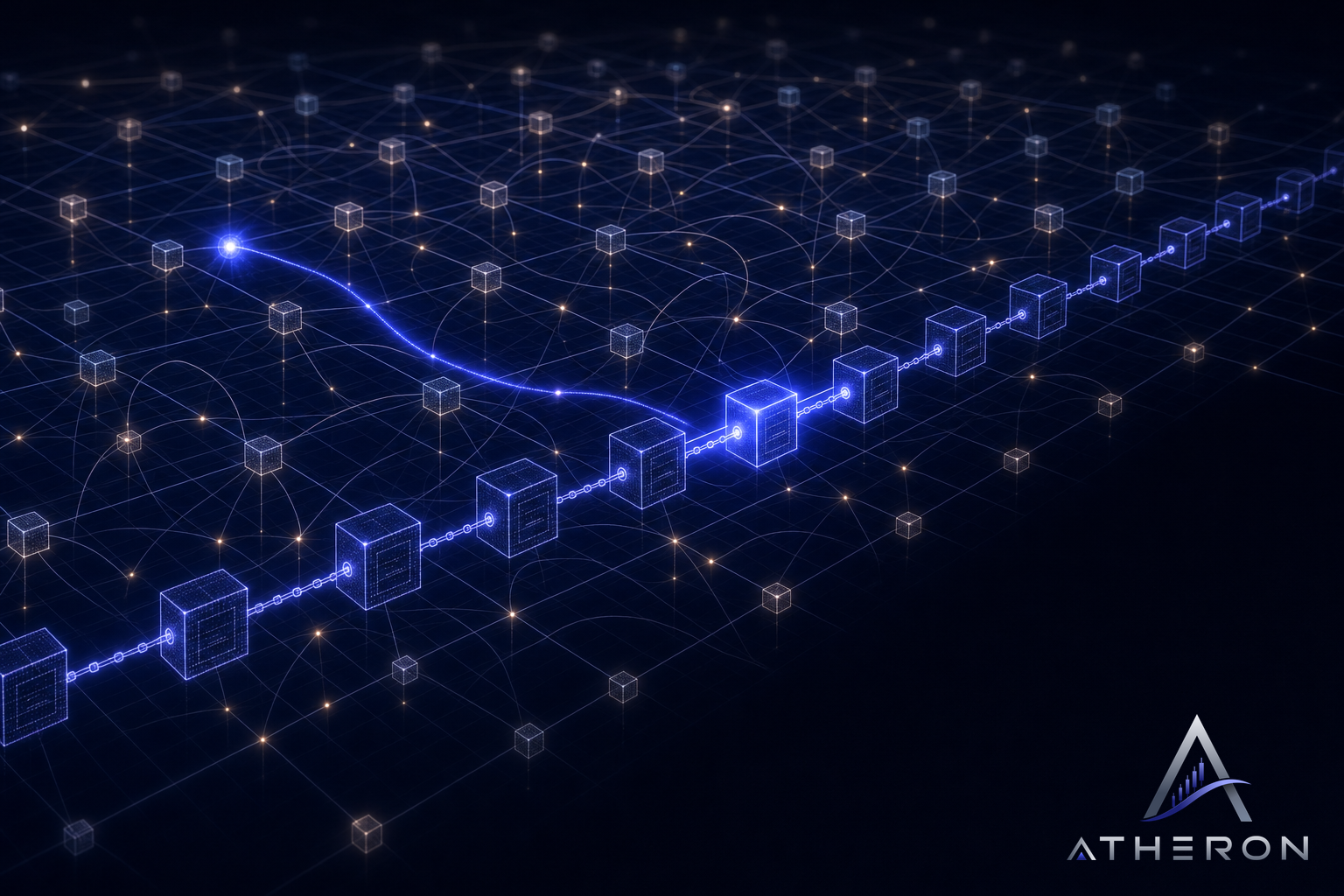
ATON Blockchain is a public blockchain for payments, and it is still being built. Its coin is also called ATON. New blocks will be made by miners, and the hardware we have in mind for that job is an ordinary graphics card.
This article looks at one question behind that choice. When a chain uses proof of work, something has to decide who can compete well. For ATON, we want that something to be memory, not raw calculating speed. Here is why, in plain words.
What a miner does
A miner gathers waiting payments into a block. To have that block accepted, the miner must show that real work went into it. The work is a puzzle with no shortcut. You try an answer, check it, and try again, many times over, until one answer meets the target.
The network can check a winning answer quickly. Finding one takes effort. That gap between easy to check and costly to find is what proof of work means.
The interesting part is the shape of the effort. Every puzzle leans on some resource. Whatever it leans on hardest becomes the thing that decides who wins.
Speed versus memory
If a puzzle only needs fast arithmetic, then the winner is whoever can do the most arithmetic for the least money and power. That favours machines built for that one task and nothing else. Once such machines exist, ordinary hardware stops being worth running for that puzzle.
A memory-hard puzzle is built differently. Each attempt has to read and write a large amount of data, jumping around it in an order that cannot be guessed ahead of time. You cannot skip the memory, and you cannot squeeze it into a tiny space. So the limit on each attempt is how much memory you have and how fast you can move data in and out of it.
Memory is a resource that general hardware already has in good supply. That changes who can compete.
Why a graphics card fits
A graphics card is made to move large amounts of data quickly. That is its everyday job. A puzzle that leans on memory plays to that strength.
This is the core of our choice. ATON uses one memory-hard proof of work, and the target hardware is the kind of graphics card many people already own or can buy. We want mining to be something you can do with general-purpose equipment, not something reserved for whoever builds a single-purpose machine first.
Using one proof of work also keeps the rules simple. There is one puzzle to understand, one kind of work to check, and one type of hardware to plan around.
What this does not promise
We want to be plain about the limits.
- A memory-hard design narrows the advantage of special-purpose machines. It does not make such machines impossible. No proof of work can promise that forever.
- Owning a graphics card does not mean mining will pay. We make no claim about what ATON is or the predicted value, and we give no financial advice.
- Nothing has launched. Mining starts with the first block, and that block has not been made.
How blocks fit together
With many miners on ordinary hardware, two or more can find a block at about the same time. On ATON, that is expected and allowed. A GHOSTDAG-style rule takes blocks made in parallel and puts them into one agreed order, so the network keeps a single shared history.
This matters for the mining choice. Work done on a block found at the same moment as another is not simply thrown away, which suits a network where many people mine at once.
How mining ties to the fair launch
The hardware choice and the launch plan point the same way. The plan is a fair launch: no premine and no sale. Nothing is sold on the site. New ATON reaches people through mining.
There is a hard cap of one billion ATON. It is paid to miners through a long emission that slows into a small tail. The exact emission curve is not specified yet.
There is one planned exception, the team allocation. Its size and its vesting will be published before the first block. Neither is decided yet.
Where this leaves you
If you own a graphics card, the idea is that you will be able to take part in mining once the chain launches. Until then, the useful thing to do is read how the design works and watch what we publish before the first block.
You can follow the project at the ATON Blockchain site.