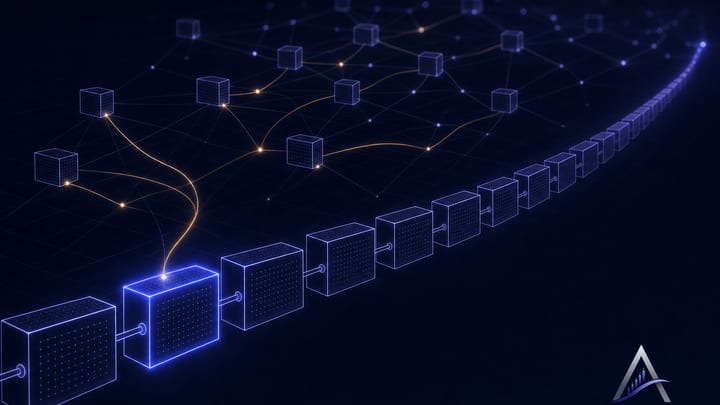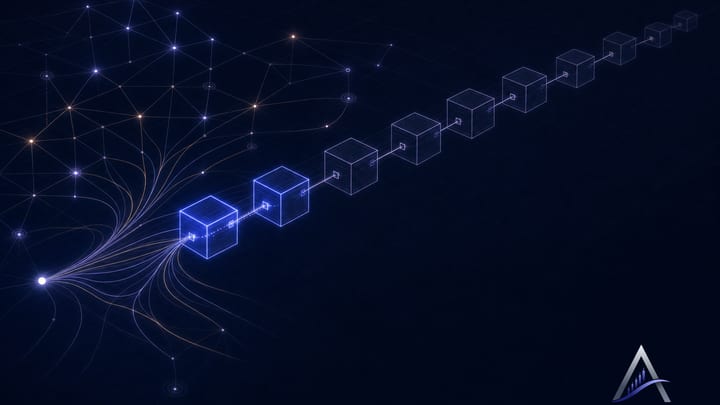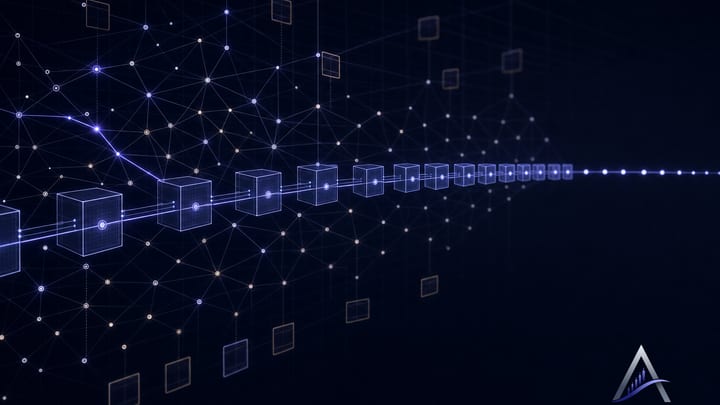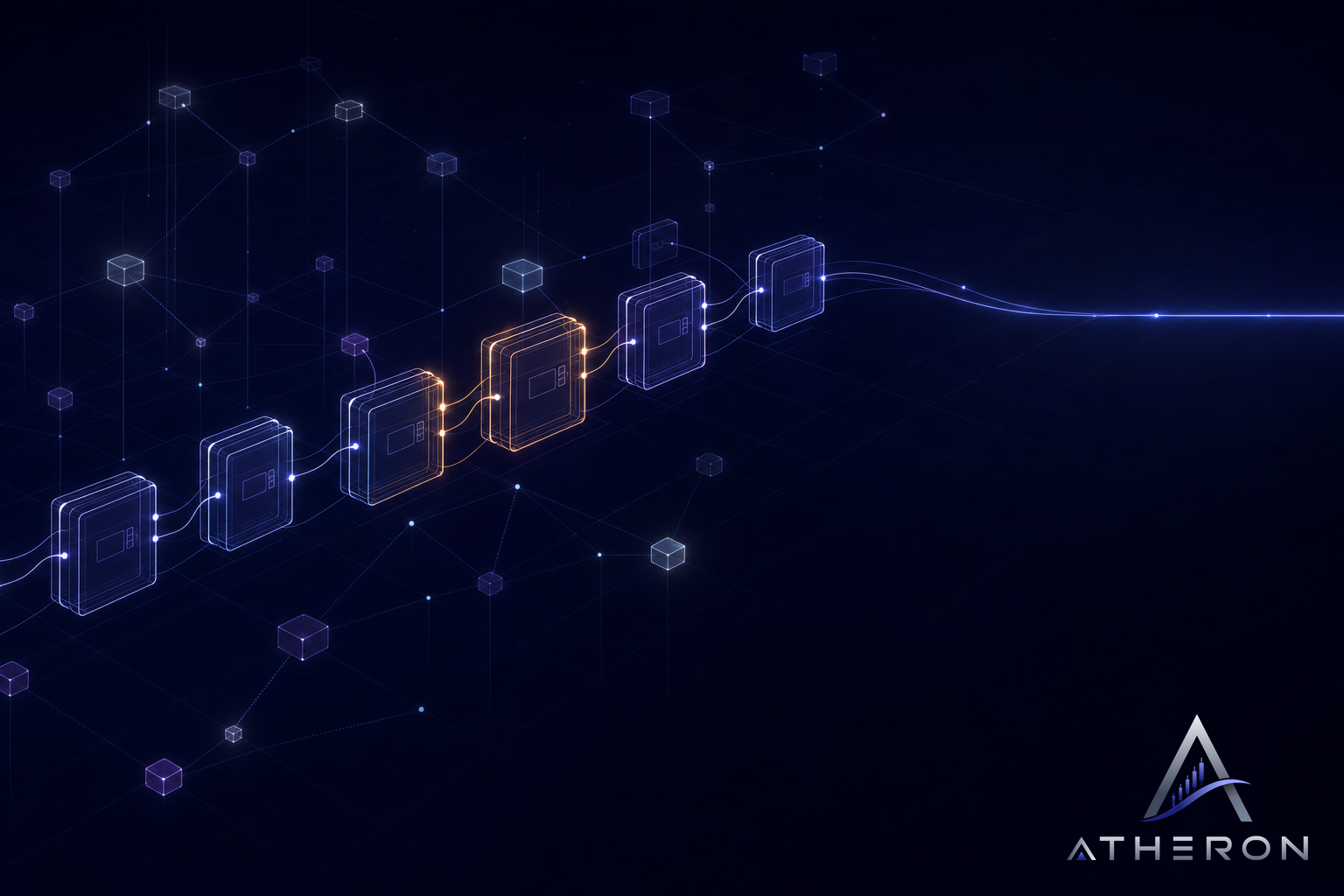
Most people picture a blockchain as a single line. One block, then the next, then the next. ATON does not work that way, and this article walks you through what happens instead, one step at a time.
We have written about the idea before. Here we want to follow a few blocks from the moment they are found to the moment they sit in one agreed order, so you can see the mechanism rather than just the summary.
Why blocks arrive together
ATON is a public blockchain for payments, mined with an ordinary graphics card using one memory-hard proof of work. Many miners work at once, all over the world. Sometimes two or more of them find a valid block at nearly the same moment.
In a single-line chain, only one of those blocks can win. The others are thrown away, and the work behind them is lost. ATON keeps them. Blocks can be made at the same time, and a GHOSTDAG-style rule puts them in one order afterwards.
The structure that results is called a block-DAG. You can think of it as a braid rather than a rope. Several strands run side by side, and they keep crossing back into each other.
Step 1: each block points back at what it saw
When a miner builds a block, it does not point at just one parent. It points at every recent block it knows about that nothing else points at yet. These are the loose ends at the front of the braid.
So if Alice and Bob each find a block at the same time, neither knows about the other. Both point back at the same earlier block. A moment later, Carol hears about both and builds a new block that points at Alice's and Bob's together. The two strands have merged again.
Nothing is lost. Carol's block is a record that she saw both.
Step 2: find the blocks that are well connected
Now every node holds the same braid, but a braid is not a list. Payments need a list, because the order of two transactions can decide which one counts.
The rule starts by asking a simple question about each block: how well is it connected to the rest? A block that honest miners received quickly gets pointed at by many later blocks. It sits inside the main body of the braid.
A block that was held back, or that travelled slowly, has fewer links. Few later blocks point at it, and it does not point at many of the blocks made around the same time. It sits at the edge.
The rule sorts blocks into these two groups. The well-connected ones form the core. The poorly connected ones are still kept, but they are treated with less trust.
Step 3: put the core in order first
Once the core is known, the rule walks through it from the oldest blocks to the newest. Where a block points back at an earlier one, the earlier one comes first. That part is natural: you cannot see something before it exists.
Where two blocks were made at the same time and neither saw the other, the rule uses a fixed tie-break that every node applies the same way. Because every node runs the same rule on the same braid, every node gets the same list.
The poorly connected blocks are slotted in later than the core blocks around them.
Step 4: use the order to settle conflicts
This is where ordering earns its keep for payments. Suppose someone tries to spend the same coins twice, once in a block in one strand and once in a block in another.
In a rule of this style, both blocks stay in the record, but only the transaction that comes first in the agreed order counts. The later, conflicting transaction is ignored. The block that carried it is still kept, and the rest of its contents still count.
The braid records everything that was seen. The order decides what counts.
Why this helps you
If you mine, fewer of your blocks are wasted when someone else finds one at the same moment. That matters more when ordinary graphics cards are spread across many small miners rather than a few large ones.
If you send a payment, the chain does not have to slow block production down to avoid ties. Ties are expected and handled.
If you run a node, you do not need to trust anyone's word about the order. You can compute it yourself from the blocks you hold.
Honest limits
Ordering also does not remove the need to wait. A brand-new block can still be reordered as more blocks pile on top of it. The deeper a payment sits in the braid, the harder it is to move.
If you want to follow how this develops, the ATON Blockchain site is where we publish what is settled and what is still open.