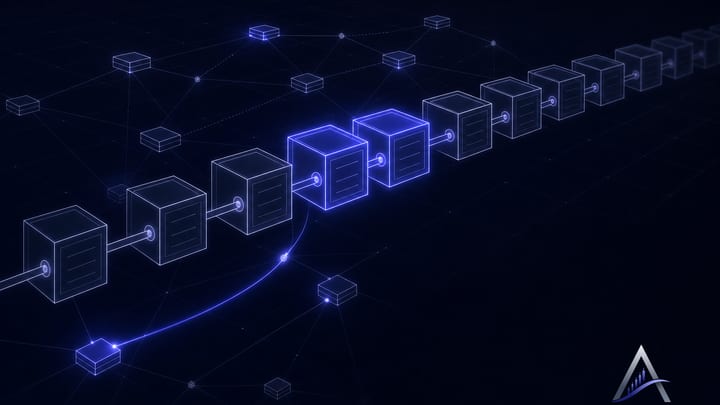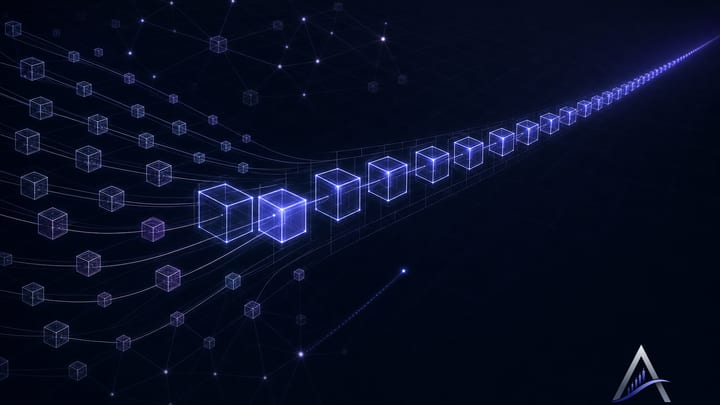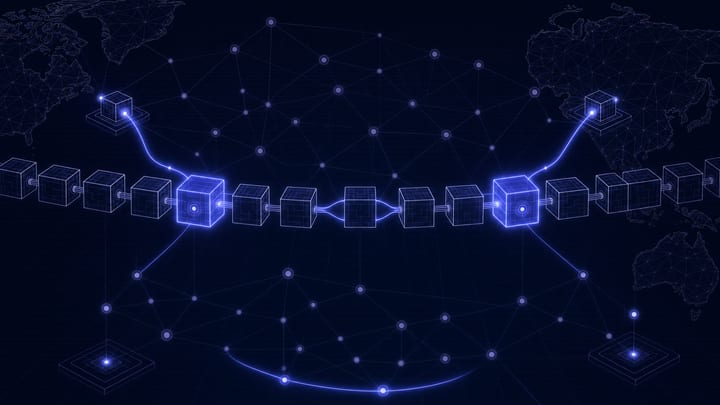
ATON is a public blockchain for payments. We are building it now, and nothing has launched yet. When it does, new coins will come from one place only: mining. And the mining is designed so that an ordinary graphics card can do the work.
This article explains what that means and why we chose it.
What the chain is
A blockchain is a shared record. Everyone who runs the software holds a copy, and the copies agree. For a payments chain, the record is a list of who sent what to whom. ATON's job is to keep that list honest without a bank or a company in the middle.
Someone has to add new blocks to the record. On ATON, that is the miners. They compete to make blocks, and the chain pays them in ATON for the blocks they make. There is a hard cap of one billion ATON. Coins are paid out through a long emission that slows over time and settles into a small tail. The exact curve is not fixed yet. We will publish it before the first block.
On ATON, more than one block can be made at the same time. A GHOSTDAG-style rule puts those blocks into one agreed order. We covered that rule in an earlier article. Here we look at the other half: the work a miner does to make a block in the first place.
Proof of work in plain words
Proof of work is a puzzle with no shortcut. The miner takes the contents of a block and runs them through a function over and over, changing a small number each time, until the result meets a target. Finding an answer takes many tries. Checking an answer takes one.
That is the point. A block is only valid if someone spent real effort on it. If you want to rewrite history, you have to redo that effort for every block you change, and do it faster than the rest of the network keeps adding new blocks. Effort is what protects the record.
The open question is what kind of effort.
Why memory-hard
Most puzzles of this kind are limited by arithmetic. A chip that does nothing but that arithmetic, built for one task, wins by a wide margin. Once such chips exist, mining moves to whoever can buy them in bulk. People with an ordinary computer stop taking part.
A memory-hard puzzle is limited by something else. Each try has to read and write a large area of memory, in an order that cannot be predicted in advance. The arithmetic is cheap. Moving data in and out of memory is the slow part. You cannot skip it, and you cannot do much of it faster by adding more arithmetic units.
Memory is a commodity. A graphics card has fast memory and a wide path to it, because that is what drawing a picture needs. So a graphics card is good at this puzzle, and a chip built only for the puzzle gains far less than it would against an arithmetic puzzle. The bottleneck is the same for everyone.
That is why ATON uses one memory-hard proof of work, and only one.
What this gives you
- You can mine with hardware you may already own. A graphics card made for games or video work is enough.
- The field is wider. More people can take part, so blocks come from more places, and the record depends on fewer single points.
- The start is the same for everyone. There is no premine and no sale. Coins reach people through mining. The one planned exception is a team allocation, and its size and vesting will be published before the first block. Neither is decided yet.
Honest limits
Memory-hard does not mean immune. It raises the cost of special hardware. It does not make such hardware impossible, and we cannot promise it will never exist. Someone with many cards and cheap electricity will still mine more than someone with one card. What the design does is keep the entry point low and keep the gap smaller than it would otherwise be.
Mining also uses power. A graphics card working flat out draws real electricity. Whether that is worth it to you is your decision. We make no forecast about ATON's value, and we give no advice on that.
And again: nothing has launched. The emission curve is not set. The team allocation is not set. When those numbers exist, they will be published before the first block, not after.
In one line
ATON is mined with a graphics card because the puzzle is built around memory, not arithmetic, and memory is something you can already buy and probably already own. That keeps the door open to more miners, which is what a payments chain needs to stay honest.
You can follow the build at aton-chain.com.