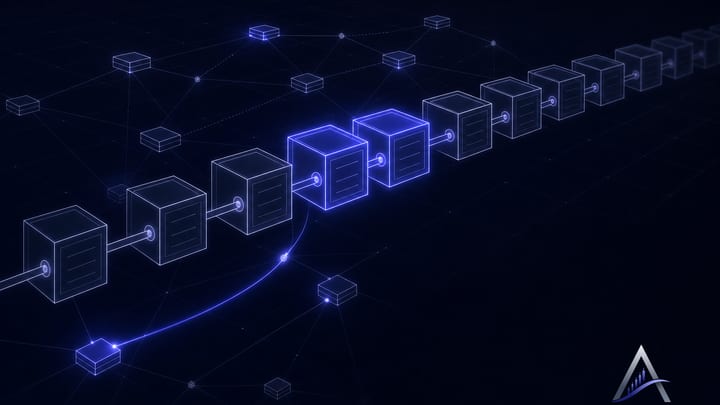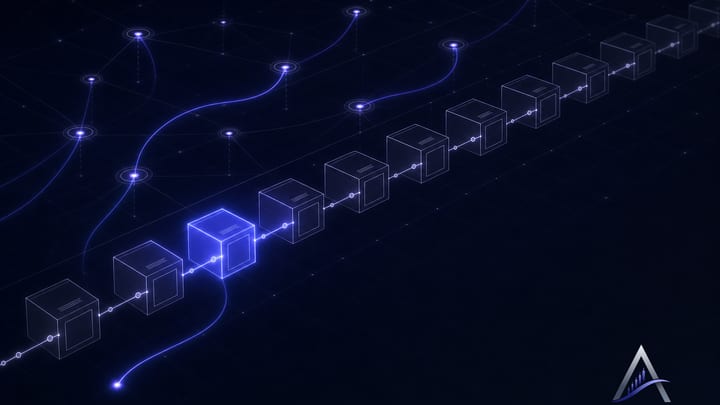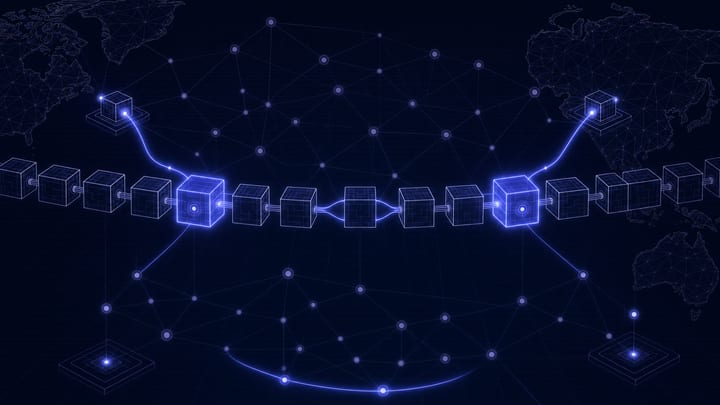
Most blockchains work like a single queue. One miner wins, one block is added, and everyone waits for the next. If two miners finish at the same moment, only one block survives and the other is thrown away.
ATON is being built differently. Miners can make blocks at the same time, and the chain keeps them. That raises an obvious question. Payments need a single order. If two blocks each spend the same coin, only one of those payments can count. So how does a web of blocks become one list that every node agrees on?
What a block-DAG is
In a plain chain, each block points to one parent. In ATON, each new block points to every recent block its miner has seen that nothing else has pointed to yet. The result is not a line but a web. Blocks only ever point backward in time, never forward, and nothing loops. That structure is what people call a block-DAG, a directed graph with no cycles. You can think of it as a chain that is allowed to be wide.
The web itself is not the problem. The problem is reading it. Two nodes looking at the same web must come out with exactly the same ordered list, using nothing but the blocks themselves. That is the job of the ordering rule.
Step one: find the well-connected blocks
The rule starts from a simple observation about honest behaviour. An honest miner hears about new blocks quickly and points to them. So honest blocks, taken together, are tightly connected. Each one references most of the blocks made shortly before it, and is referenced by most of the blocks made shortly after.
A block made in isolation looks different. If someone mines in private and releases blocks late, those blocks point to little, and little points back to them. They sit loosely at the edge of the web.
The rule uses this difference. It picks out the largest group of blocks that are all closely connected to one another and treats that group as the main body of the chain. Blocks that are poorly connected are still kept, but they are placed after the main body, not inside it.
Step two: pick a spine through the main body
Inside the well-connected group, the rule chooses a spine. Starting from the newest blocks and walking backward, it prefers at each step the block whose connected past is heaviest. This is close to the familiar idea of following the chain with the most work behind it. The difference is that the weight counts the whole connected web behind a block, not just one thin line of ancestors.
Because the spine is chosen by weight, extending it honestly is the easiest way to add to it. Withholding blocks does not help, since withheld blocks end up poorly connected and carry little weight.
Step three: fill in the rest
The spine gives a backbone. Each spine block then pulls in the blocks it references that have not been placed yet, in a fixed order. Where two blocks are genuinely equal, a tie-break based on the block hash decides, so every node breaks the tie the same way.
The outcome is a single list. Every block in the web has one position in it, and any node that holds the same blocks produces the same list. No one votes, no one coordinates, and no one is trusted. The order is a pure function of the data.
What the order means for a payment
Once the list exists, transactions are applied in list order. If a later block contains a payment that conflicts with an earlier one, the later payment is simply skipped. The block that carried it still counts, and the miner's work still stands.
This is the practical point of the whole design. Work is not discarded because two miners were close in time. More blocks per unit of time means more room for payments, without asking miners to race for a single slot.
Table: A single chain and a block-DAG side by side
| Single chain | Block-DAG | |
|---|---|---|
| Blocks at the same time | One survives | All are kept |
| Each block points to | One parent | All recent unreferenced blocks |
| Order comes from | Position in the line | A rule applied to the whole web |
| Conflicting payments | Lose with their block | Later one skipped, block stays |
Honest limits
Ordering is not the same as finality. The position of a very recent block can still shift a little as newer blocks arrive and the spine settles. The deeper a block sits, the more connected weight is built on top of it, and the harder it becomes to move. How long you should wait for a payment of a given size is a question we will answer with published parameters, not with a promise today.
If you want to follow the work as it lands, the project home is at aton-chain.com.