ATON is a public blockchain for payments, and it is still being built. Its coin is also called ATON. You mine it with an ordinary graphics card, using one memory-hard proof of work.
One design choice shapes almost everything else about the chain. Blocks can be made at the same time, by different miners, and the network keeps them. A GHOSTDAG-style rule then puts all of those blocks into one agreed order. This article explains why that matters and what it does for you, in plain words.
Why blocks arrive at the same time
Miners are spread across the world. When one of them finds a block, it takes time for the news to reach everyone else. In that gap, another miner who has not heard yet may find a block too.
On many chains, only one of those two blocks can survive. The other is thrown away, and the work that went into it is lost. The faster you try to make blocks, the more often this happens.
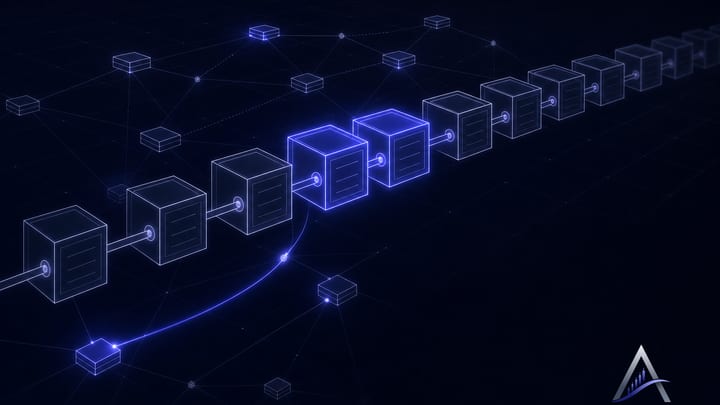
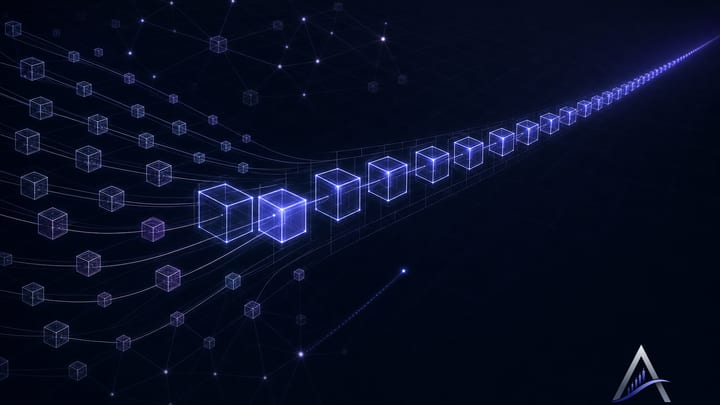
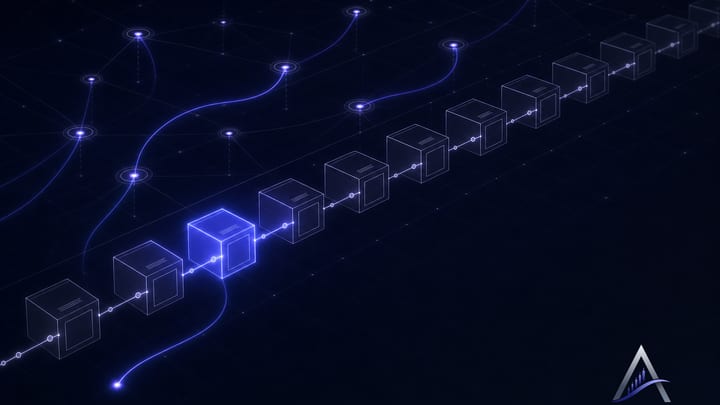
ATON takes a different route. Each new block points back to every recent block its miner has seen, not just one. So the history is not a single line. It is a web, which is what people mean by a block-DAG.
A web is not enough on its own
A web of blocks has a problem. Payments need an order. If you send the same coins twice, once in each of two parallel blocks, the network has to decide which payment came first. Only one can count.
So every node needs to look at the same web and reach the same answer about the sequence. No vote, no coordinator, no trusted party. Just a rule that every node applies to the blocks it holds.
How the rule turns a web into a line
Here is the idea without the jargon.
Think of each block as a report. When a miner builds a block, it says, in effect, "these are the blocks I had seen when I started." Honest miners who are well connected tend to see nearly the same things, so their blocks reference each other heavily. They form a tight, well-linked group.
A block that was hidden, or that ignored what everyone else could see, sits off to the side. Few blocks point to it, and it points to few of them.
The ordering rule leans on that difference:
- It finds the large, well-connected group of blocks that most of the network built on together.
- It puts that group in order first, following the links between them.
- It slots the poorly connected blocks in afterwards, so they cannot jump ahead of the honest history.
Every node runs the same steps on the same blocks, so every node gets the same line. That line is the order the chain uses.
What the order means for your payment
Once the blocks are in one line, conflicts are simple to settle. If two payments try to spend the same coins, the one that comes earlier in the order counts. The later one is ignored.
For you, that is the whole point. You do not need to know which miner made which block, or whether two blocks appeared at once. You need a clear answer to one question: did my payment happen? The agreed order gives everyone the same answer.
It also means work is not wasted. Parallel blocks still become part of the history instead of being dropped, so the chain does not have to slow itself down to avoid collisions between miners.
Honest limits
A few things are worth saying plainly.
- Nothing has launched. The chain is being built, and everything here describes how it is designed to work.
- Ordering is not magic. The rule relies on most of the mining work being honest and on blocks spreading across the network in reasonable time. That is true of proof of work chains in general.
- Some economics are open. There is a hard cap of one billion ATON, paid to miners through a long emission that slows into a small tail. The exact emission curve is not specified yet.
Where this fits
Parallel blocks and a shared order are what make ATON a block-DAG rather than a single chain. Mining with a graphics card decides who gets to make blocks. The ordering rule decides how those blocks fit together. Both serve the same goal, a payment chain where you can tell, clearly, what happened and in what sequence.
If you want to follow the work as it moves toward launch, the ATON Blockchain home page is where we post it.